
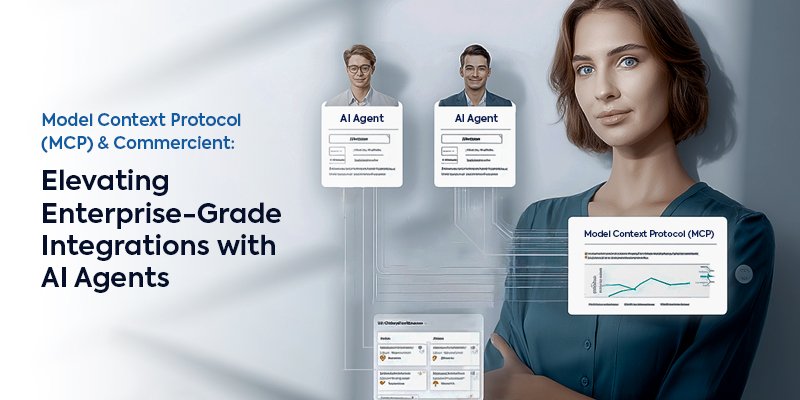
At Commercient, we are continuously pushing the boundaries of what’s possible when it comes to ERP-CRM integrations. With our focus on providing seamless data synchronization between over 150 ERP systems and various CRM and eCommerce platforms, we’ve built a robust ecosystem that helps businesses optimize their operations. Now, we’re taking it a step further by introducing Model Context Protocol (MCP), a groundbreaking addition that will layer on top of our existing AI-powered integration solutions.
MCP is designed to enhance the way Commercient’s systems interact with data, providing a contextual framework for AI agents to securely and reliably access enterprise-grade connectors. This new protocol will not only streamline integrations but also ensure that data flows between systems in a contextually relevant manner, empowering AI agents to make smarter, more informed decisions.
This upcoming feature builds on the solid investments we’ve made in European CRM, e-commerce, and hundreds of other integrations, creating a secure foundation for businesses to connect their systems and leverage the full potential of AI-driven workflows.
With MCP, Commercient’s platform will deliver even more efficient, scalable, and secure integrations, helping businesses manage their data more effectively and make better decisions, faster.
What is Model Context Protocol (MCP)?
Model Context Protocol (MCP) is a framework designed to enhance data integration and AI-driven processes by providing contextual intelligence, security, and reliability. At its core, MCP ensures that data flows between systems—whether CRM, ERP, or e-commerce—are not only accurate but also contextually appropriate for each use case. It acts as a bridge between siloed systems, allowing AI agents to securely access and interact with data while maintaining strict authorization controls.
By integrating MCP into Commercient’s platform, we are empowering AI agents to securely access and utilize enterprise-grade connectors across hundreds of systems. This ensures that AI agents can work within context and only access the data they are authorized to use, reducing security risks and improving operational efficiency. Whether it’s synchronizing customer data, inventory levels, or sales orders, MCP guarantees that the right data is always used at the right time, in the right context, and by the right agents.
With MCP, businesses can seamlessly connect their systems, automate workflows, and drive smarter decision-making—while ensuring the security and integrity of their data. This protocol lays the foundation for future innovation, enabling Commercient to provide more advanced AI-driven capabilities and deliver scalable, reliable solutions to businesses worldwide.
Which Key Features Does MCP Bring to Commercient?
Enterprise-Grade Connectors
MCP unlocks the power of secure, reliable, and high-performance enterprise-grade connectors across a wide range of platforms. Whether it’s CRM, ERP, or e-commerce systems, MCP enables seamless and scalable integrations, connecting businesses to the tools and data they need. By exposing these connectors securely, MCP ensures that companies can access vital data and services with ease, whether it’s customer data from Salesforce or transactional information from an ERP system.
This flexibility allows businesses to leverage powerful AI-driven applications, such as predictive analytics for inventory management, personalized customer interactions, or automated financial reporting, all while maintaining a secure and reliable data flow.
Security and Authorization
In today’s interconnected world, security is paramount. MCP takes data security to the next level by ensuring that only authorized agents can access sensitive information. With robust encryption and fine-grained authorization controls, MCP ensures that data can be transferred safely across platforms.
Authorization safety is a core feature of the protocol, meaning AI agents can only interact with data they are explicitly permitted to use. This reduces the risk of unauthorized access, offering peace of mind to businesses while enabling compliance with industry standards. For example, a customer service AI agent may only access customer profile information but not sensitive financial data, ensuring confidentiality and privacy in every interaction.
Contextual Data Flow
MCP is built to handle real-time data flows with an unmatched level of contextual intelligence. As data is transferred between integrated systems, MCP ensures that it is always relevant to the task at hand. AI agents can now make more informed decisions, powered by data that is not just accurate, but also contextually aligned with the current situation. This means businesses can automate decisions based on the most up-to-date information, such as adjusting inventory levels dynamically based on real-time sales data or optimizing marketing campaigns based on current customer behavior patterns. By ensuring that the data being accessed and used is both timely and context-specific, MCP enables smarter, faster decision-making that drives efficiency across all areas of a business.
MCP is the key to unlocking the full potential of Commercient’s integrations, ensuring that AI-driven processes are not only secure and reliable but also contextually intelligent and timely. With these powerful features, businesses will be equipped to take their integration strategies to the next level.
How MCP Enhances Commercient’s AI Agents
Enabling Smarter Integrations
MCP empowers Commercient’s AI agents to seamlessly integrate and interact with data across CRM, ERP, and e-commerce systems in a way that’s both intelligent and secure. By ensuring that the data flowing through these systems is contextually relevant, MCP enhances the AI agents’ ability to make more informed, data-driven decisions. For example, when an AI agent accesses a CRM like Salesforce, it can now determine not only which customer data to retrieve but also the precise context—whether it’s for a sales call, an order fulfillment process, or a customer service inquiry. This ensures that the right data is utilized at the right time, with no irrelevant or unnecessary information slowing down decision-making.
With MCP in place, integrations become more effective, ensuring that data synchronization between systems is both timely and accurate. This leads to smoother operations, such as more accurate sales forecasting from ERP data, or better-targeted marketing campaigns in CRM systems, resulting in higher efficiency and reduced manual effort.
Automating Data Access and Workflow
The integration of MCP brings significant improvements to the automation capabilities of Commercient’s AI agents. By providing a contextual framework for AI agents to operate within, MCP allows for the secure and automated flow of data across platforms. AI agents can now perform tasks without constant human oversight, making workflows more streamlined and reducing the potential for human error.
For instance, consider inventory updates: AI agents, using MCP, can automatically sync product stock levels between ERP and e-commerce platforms in real time, adjusting stock based on live sales data. In sales lead tracking, AI agents can now pull the most relevant information from CRM systems, alert sales teams to high-priority leads, and even update lead statuses, all based on predefined business rules and the contextual data available.
In customer service automation, AI agents can instantly access and use data from CRM systems, such as past interactions or open tickets, to provide fast, personalized support to customers. This level of automation frees up valuable time for employees to focus on high-priority tasks, while ensuring that each interaction is informed and relevant.
Thanks to MCP, these processes are not only automated but also contextually aware, ensuring that the right decisions are made based on the most relevant, up-to-date data—leading to a smoother, more efficient business operation.
How Can You Use MCP With Commercient AI SYNC? Specific Use Cases Enabled by MCP
The addition of MCP to Commercient’s platform unlocks a range of practical, high-impact applications across industries by enhancing data security, context-awareness, and AI-driven automation. Here are some concrete examples of how MCP powers real-world business scenarios:
- Automated Inventory Management
Using MCP, AI agents can securely access up-to-date inventory data across ERP and e-commerce platforms to automate stock levels. For instance, when a product sells online, the inventory counts are updated in the ERP system, triggers replenishment orders if stock is low, and notifies teams—all while ensuring that only authorized systems and users can access sensitive inventory data. - Intelligent Sales Lead Prioritization
MCP enables AI agents to pull contextually relevant customer and opportunity data from CRM systems like Salesforce, combined with financial and operational data from ERP platforms. This allows sales teams to focus on high-priority leads based on up-to-date credit status, order history, or product availability, improving conversion rates without exposing sensitive data beyond authorized access. - Personalized Customer Service Automation
Customer service AI agents, powered by MCP, can access only the customer records and support histories they’re authorized to see. This allows agents to deliver personalized, context-aware support—such as troubleshooting based on recent orders or service requests—without risking data leakage or privacy violations. The result is faster, more accurate service that enhances customer satisfaction. - Dynamic Pricing and Promotion Management
AI agents using MCP can analyze updated sales data, inventory levels, and customer segmentation data to adjust pricing and promotions dynamically across sales channels. For example, if inventory for a specific product is running low but demand is high, the AI agent can suggest price adjustments or special offers to optimize revenue while ensuring all changes comply with company policies and authorization rules. - Compliance-Driven Data Sharing Across Departments
In regulated industries like healthcare or finance, MCP ensures that data sharing between departments or external partners happens securely and within compliance boundaries. AI agents can mediate data requests by verifying authorization, providing only the necessary contextual data, and maintaining audit logs—all while enabling seamless collaboration and operational efficiency.
These use cases demonstrate how MCP strengthens Commercient’s ability to deliver secure, intelligent, and context-aware integrations, helping businesses automate complex workflows, improve decision-making, and protect critical data across their entire technology stack.
The Future of Commercient with MCP
As Commercient continues to grow and evolve, the introduction of MCP will lay the groundwork for even greater flexibility and scalability across diverse industries and use cases. With MCP enabling secure, contextual, and intelligent data access across a wide array of systems—whether CRM, ERP, or e-commerce—Commercient’s platform will be able to serve a broader range of business needs.
In the future, MCP could lead to even more advanced AI capabilities—such as deeper natural language processing for customer service automation, more precise predictive models for sales and inventory management, or even fully autonomous decision-making systems that operate across multiple platforms simultaneously. By embedding these innovations into the platform securely and contextually, MCP ensures that Commercient’s customers will always be able to stay ahead of the curve in an increasingly digital and data-driven world.


